
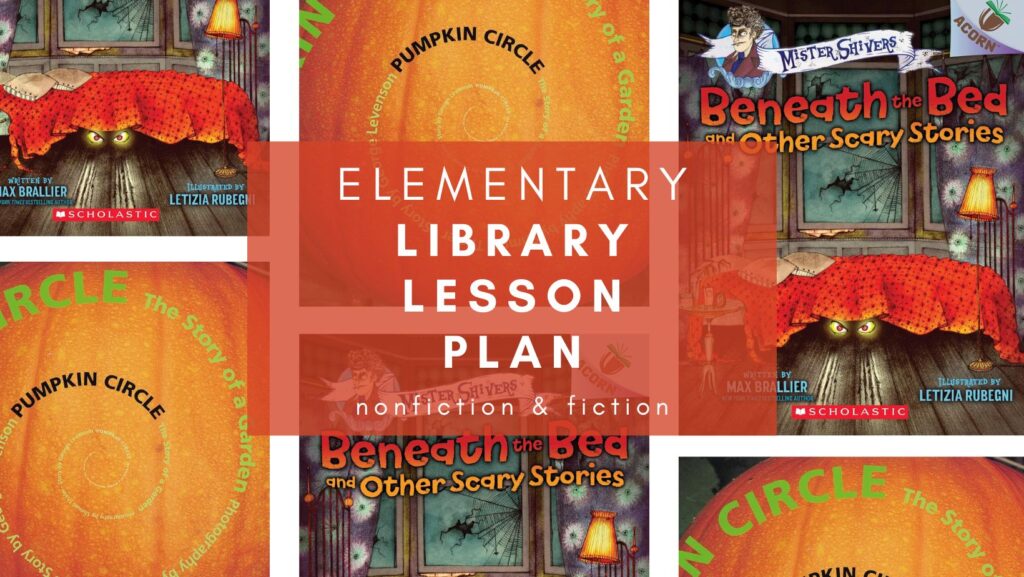
This elementary school library lesson plan is a great starting off point for a lesson, as well as for a teacher evaluation template.
*We use affiliate links and may earn commission from purchases made through those links. All opinions are our own.
Elementary School Library Autumn Lesson Plan
Interdisciplinary Connections
Connections can be made to Science and ELA
Lesson Duration
One 30 minute class period
Relevance/Rationale
Students will engage in a comparison between fiction and nonfiction. They will also learn about the life cycle of a pumpkin. Students will be able to relate what they learn in class with the holiday celebrations in their classrooms and at home.
Outcomes/Objectives
- Identify a fiction book and a nonfiction book – Students will stand up if they think the book we read is fiction or sit down if they think the book we read is nonfiction
- Discuss attributes of pumpkin life cycles – Students will be asked to describe to their peers characteristics of pumpkins
Content Standard and Common Core Learning Standard
AASL National School Library Standards for Learners
I. Inquire
Building new knowledge by inquiring, thinking
critically, identifying problems and developing
strategies for solving problems.
D. Grow – Learners participate in an ongoing
inquiry-based process by:
I.D.1 Continually seeking knowledge.
I.D.3 Enacting new understanding through
real-world connections.
IV. Curate
Make meaning for oneself and others by collecting,
organizing and sharing resources of personal
relevance.
A. Think – Learners act on information by:
IV.A.2 Identifying possible sources of
Information.
IV.A.3. Making critical choices about
information sources to use.
B. Create – Learners gather information
appropriate to the task by:
IV.B.1 Seeking a variety of sources.
V. Explore
Discover and innovate in a growth mindset
developed through experience and reflection.
A. Think – Learners develop and satisfy personal
curiosity by:
V.A.1 Reading widely and deeply in multiple
formats and create for a variety of purposes.
Common Core Standards
Reading Literature
Integration of Knowledge and Ideas
CC.2.RL.7 Use information gained from the illustrations and words in a print or digital text to demonstrate understanding of its characters, setting, or plot.
Key Ideas and Details
CC.2.RL.3 Describe how characters in a story respond to major events and challenges.
Reading Informational Text
Range of Reading and Level of Text Complexity
CC.2.RI.10 By the end of year, read and comprehend informational texts, including history/social studies, science, and technical texts, in the grades 2–3 text complexity band proficiently, with scaffolding as needed at the high end of the range.
Reading Foundational Skills
Fluency
CC.2.RF.4.a Read on-level text with purpose and understanding.
Speaking and Listening
Comprehension and Collaboration
CC.2.SL.1 Participate in collaborative conversations with diverse partners about grade 2 topics and texts with peers and adults in small and larger groups.
CC.2.SL.1.a Follow agreed-upon rules for discussions (e.g., gaining the floor in respectful ways, listening to others with care, speaking one at a time about the topics and texts under discussion).
Illinois Standards-Aligned Instruction for Libraries
Standard 2 – Evaluate information critically and
competently
- Distinguish among fact, point of view, and opinion
- Identify inaccurate and misleading information
Use of Formative Assessment to Inform Planning
Students should have a basic understanding of pumpkins based on personal experiences and classroom discussions. They will learn more about the pumpkin’s life cycle. Students have been introduced to fiction and nonfiction and are practicing distinguishing between the two. Also, students often engage with fiction and nonfiction text in the library. With this background, students should be able to be active participants.
Overview
We will be reading a scary story (fiction text) and a book about pumpkins (nonfiction text) before checking out books to take home.
Technologies and Other Materials/Resources
Books
- The Burger and the Hot Dog by Jim Aylesworth and Stephen Gammell
- Pumpkin Circle: The Story of a Garden by George Levenson
- Beneath the Bed and Other Scary Stories by Max Brallier
Materials
- Names of students in a bag
- Technology
- Computer
- Scanner
- Follett Destiny
Grouping Strategy
We will learn all together as a class. The rationale for learning together as a class is to build group listening skills, as well as collaboration skills
Academic Vocabulary
Pumpkin
While almost all students will be able to identify a pumpkin, at the end of the lesson, they should be able to discuss the life cycle of a pumpkin.
Lesson Procedures
- Students will enter the library and drop any books to be returned in the yellow bin. Students will find their seats. [1 minute]
- We will begin with reading the poem “Poor Bar” from The Burger and the Hot Dog by Jim Aylesworth and Stephen Gammell. We have been reading a poem from this book at the beginning of each library class. [3 minutes]
- We will read Pumpkin Circle: The Story of a Garden by George Levenson. After reading the text, students will stand up if they think the book was fiction or sit down if they think the book was nonfiction. [5 minutes]
- We will read a story from Beneath the Bed and Other Scary Stories by Max Brallier (pages 35-44). After reading the text, students will stand up if they think the book was fiction or sit down if they think the book was nonfiction. [5 minutes]
- Students will be called on (four or five at a time) to pick out books to check out and take home from the available areas. While students select books, their peers will discuss attributes of pumpkins. [Combined with the next task, this will take about 15 minutes]
- “What is something we learned about pumpkins today?”
- “What happens when a pumpkin is first starting out? What happens at the end of a pumpkin’s life?”
- Students will sit in their seats to look at their library books while I call students (three or four at a time) to the circulation desk to check out their books. [Combined with the above task, this will take about 15 minutes]
- Students will stack their books, hug them closely, and line up in their specific order. [1 minute]
Differentiation
I will provide students with additional time to think of answers. I will also provide a picture chart with the library rules, as well as a picture chart for the order of activities in the library.
Assessment Criteria for Success
I will assess the students learning throughout the lesson with their standing up and sitting down. I will assess the students learning with their stand up/sit down identification of fiction and nonfiction. Students will know if they successfully met the outcomes if they stood up/sat down correctly.